aerostack

Search Aerostack

Norwegian

Rydoo Accounts Payable AI invoice automation at Norwegian

MidAmerica St. Louis

GoodMaps indoor navigation at MidAmerica St. Louis Airport

Lyon Saint-Exupéry Airport

Stan robotic valet parking at Lyon Saint-Exupéry

London Heathrow

Facial-recognition eGates at Heathrow

Almaty International Airport

Q-Gate biometric passport-control terminals at Almaty

Pittsburgh International Airport

Arrow Analytics EZ-Board computer-vision carry-on analytics test at PIT Gate A7

Federal Aviation Administration

FAA SMART airspace and trajectory management platform

Dubai International

Dubai Police AI systems for passenger screening, unattended baggage and camera analysis at Dubai airports

Airline intelligence / EL AL

EL AL has trialled AI that watches turnarounds on camera to prevent delays

EL AL has run a pilot of IntellAct's turnaround monitoring at Tel Aviv (TLV), using cameras and machine learning to spot late tasks around the aircraft and suggest fixes. The supplier calls the pilot successful, and EL AL's innovation arm has invested in the company. No results have been published by the airline.

The operating picture

Watching the work around the aircraft

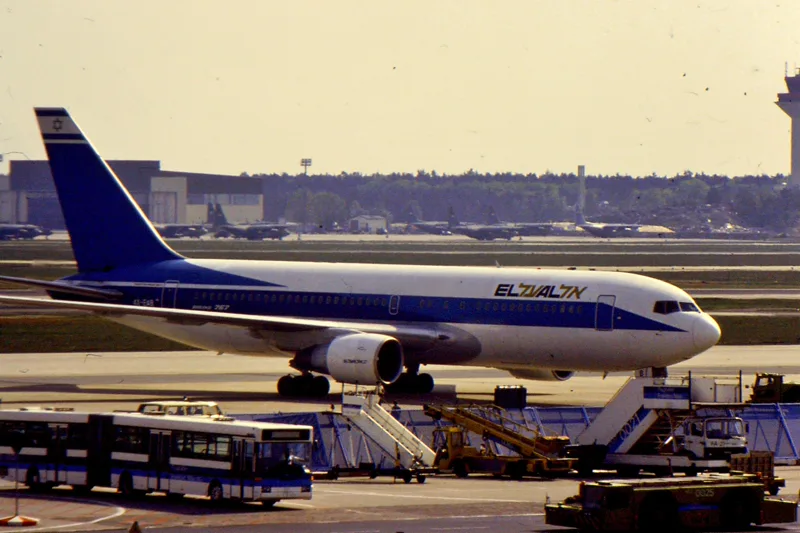
EL AL Boeing 767 on the apron at Frankfurt
EL AL Boeing 767 on the apron at Frankfurt. Photograph: G B_NZ / CC BY-SA 2.0 (cropped to fit). Illustrates the airline, not an AI deployment.

Many departure delays start in the turnaround, when cleaning, fuelling, catering and baggage handling all have to finish on time. IntellAct, an Israeli company founded in 2017, analyses video from existing airport and airline cameras to track those tasks.

EL AL's links with the company go beyond a trial: its Cockpit Innovation arm later invested in IntellAct, Jewish News reported in March 2025.

Selected implementations

The work behind the evidence

01 / Pilot

Turnaround monitoring trialled at Tel Aviv

The operational problem

A turnaround task that overruns, such as a late fuel tanker, is often noticed only when the departure slips.

What the evidence reports

Udi Segall, IntellAct's founder and chief executive, told the Times of Israel in March 2025 that EL AL had run a successful pilot of the system at TLV. Neurohive reported in February 2022 that the system uses existing cameras to detect delays in tasks such as cleaning, refuelling and baggage handling, alerts staff and proposes a mitigation plan; its example was boarding passengers while an aircraft refuels, with a fire engine standing by. It said EL AL's preliminary tests showed a 15% reduction in flight delays.

Operational significance

Using cameras already in place keeps the cost of entry low, and the system suggests what to do as well as flagging the problem.

Evidence still needed

All accounts of the pilot come from IntellAct or reports based on it. EL AL has not described the pilot, confirmed the 15% figure or said whether the system is in use today.

Sources and verification (1)

Times of Israel · Evidence grade B

A source can verify an announcement without verifying its projected outcome.

The wider register

Other tracked activity

Other records are shown separately, including non-AI technology and programmes at different stages of deployment. A register entry does not establish a measured AI benefit.

No other publicly listed records.

Editorial assessment

EL AL's documented AI is a single turnaround pilot, backed by an investment in the supplier.

Confirmation from EL AL of whether the system moved into daily operations at TLV would settle where this work stands.

Live data from the Aerostack register. Status reflects published evidence only. See Our approach for how records are graded.

Aerostack tracks AI deployments across airports and airlines, with the published evidence behind each record. Photography is real aviation imagery. Record thumbnails may show the named airport or airline; other photographs do not.